
The federal timber harvest collapse was over before the rule was written
Download this chart with sources —>
Discuss this issue on LinkedIn —>
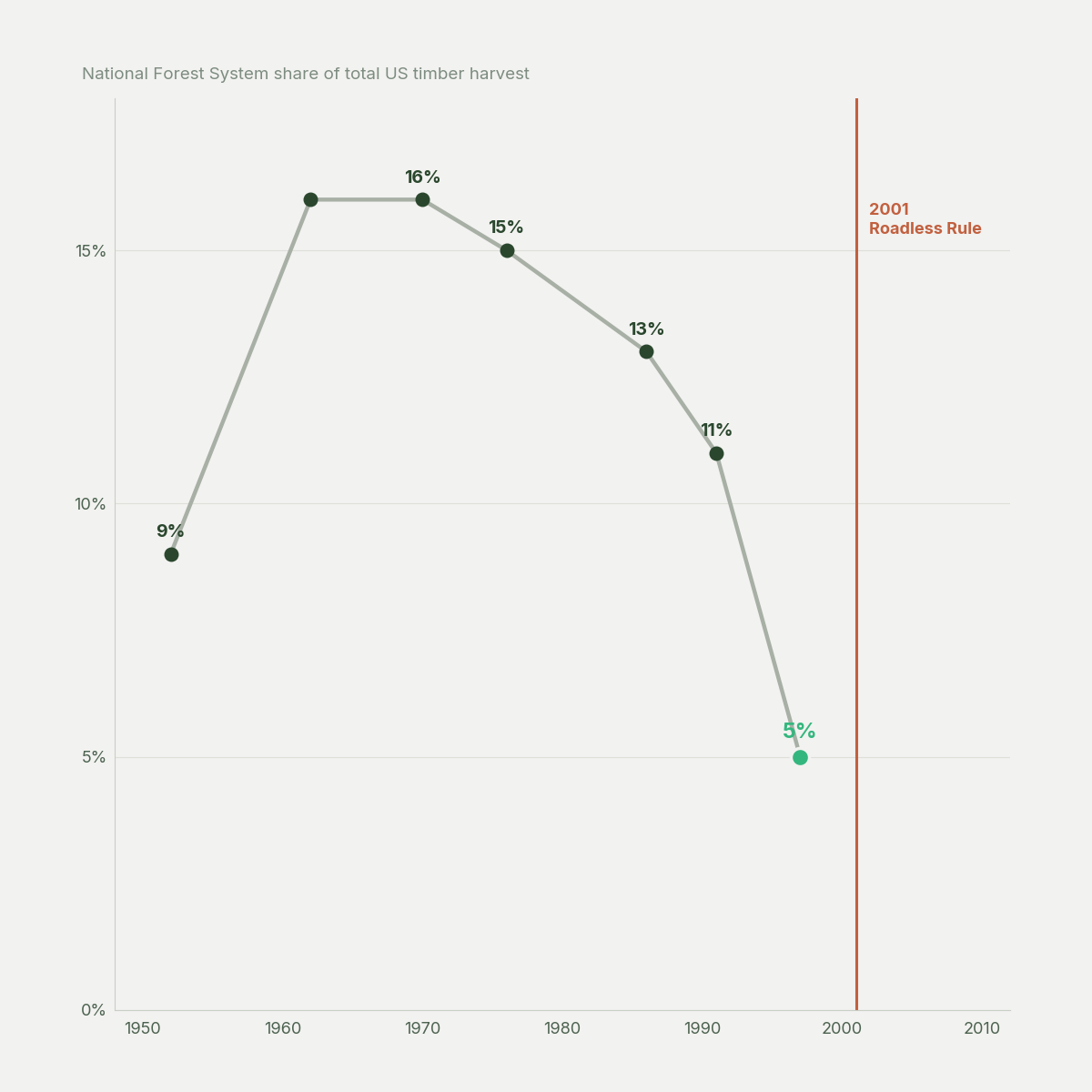
The 2001 Roadless Rule rescission is reported as 58 million acres thrown open to logging. But federal timber's share of US supply had already fallen from 16% to below 5% before the rule existed.
Market forces drove that, not road access. The Forest Service realises about $68 per thousand board feet; Washington logs deliver at $436 to $517. Logging, trucking and roads take the rest.
Move it further out or onto steeper ground and costs rise. The mill pays the same for the log, so the squeeze falls entirely on the landowner's residual.
I saw this work out in the evolution of the natural gas and LNG markets: abundant, cheaply produced Permian gas was only worth anything where pipeline capacity and transport economics made sense. Timber has the same problem on a shorter radius and much thinner margins.
Diesel at $6.29 gets the attention because it is visible. Relief at the pump reaches every hauler at once. It only moves your stand up the queue if your haul is shorter than the competing supply's.
The agency's own notice caps the effect at a 5 to 10% rise in National Forest System sawtimber harvest. Five to ten percent of a sub-5% slice is half of one percent of US supply, at the ceiling, in a scenario the agency itself calls unlikely. Timberland owners will not see that volume in competitive supply. Forest carbon projects will not see it in their baselines. And the forests people treasure are not what is in play: roadless forests stayed roadless because timber economics could not justify the road.
Method
Share is National Forest System volume as a percentage of total US timber harvest, for the years the Congressional Research Service published it on that basis. The series stops at 1997 deliberately. CRS's later figure is stated as a share of US wood and paper products — a different denominator — and splicing the two onto one line would invent a decline the data does not show. Federal volume has sat in the same 2 to 3 billion board foot band every year since; 2.95 billion was cut in FY2025.
The stumpage figure is a residual, not a price. Under 36 CFR 223.63 road construction cost is built into the appraisal as though the purchaser builds it, and 223.62 lets the purchaser offset actual road cost against stumpage owed. The purchaser never pays for the road twice. Which is why, on road-expensive ground, appraised stumpage falls to base rates or the sale is never offered at all.
Sources
Every figure here is from a free, public, licence-clean source.
Congressional Research Service, "Timber Harvesting on Federal Lands" (R45688) — the share series. https://www.congress.gov/crs-product/R45688
USDA Forest Service, Forest Products Cut and Sold, FY2026 Q1–Q3 servicewide — 1,571,802.86 MBF sold for $107,091,121.39, or $68.13 per MBF. https://www.fs.usda.gov/forestmanagement/products/cut-sold/index.shtml
Washington Department of Natural Resources, mill log price report, 26 February 2026 — Eastside camprun delivered: lodgepole $436, white fir/hemlock $454, Douglas-fir/larch $517 per MBF. https://dnr.wa.gov/product-sales-and-leasing/timber-sales/timber-sale-querylog-prices
USDA Forest Service, "Special Areas; Roadless Area Conservation," proposed rule, Federal Register, 20 August 2026 — the 58.5 million acre inventory, the 4.8 million acre operable subset, and the 5 to 10 percent ceiling. https://www.federalregister.gov/documents/2026/08/20/2026-16965/special-areas-roadless-area-conservation
US Energy Information Administration, On-Highway Diesel Fuel Price, week of 14 September 2026. https://www.eia.gov/petroleum/gasdiesel/
PRICED IN is published weekly by Real Heritage Group. What goes into a price — and what comes out of it.