
Airlines need 4-6x the credits currently available. The price halved anyway.
Download this chart with sources —>
Discuss this issue on LinkedIn —>
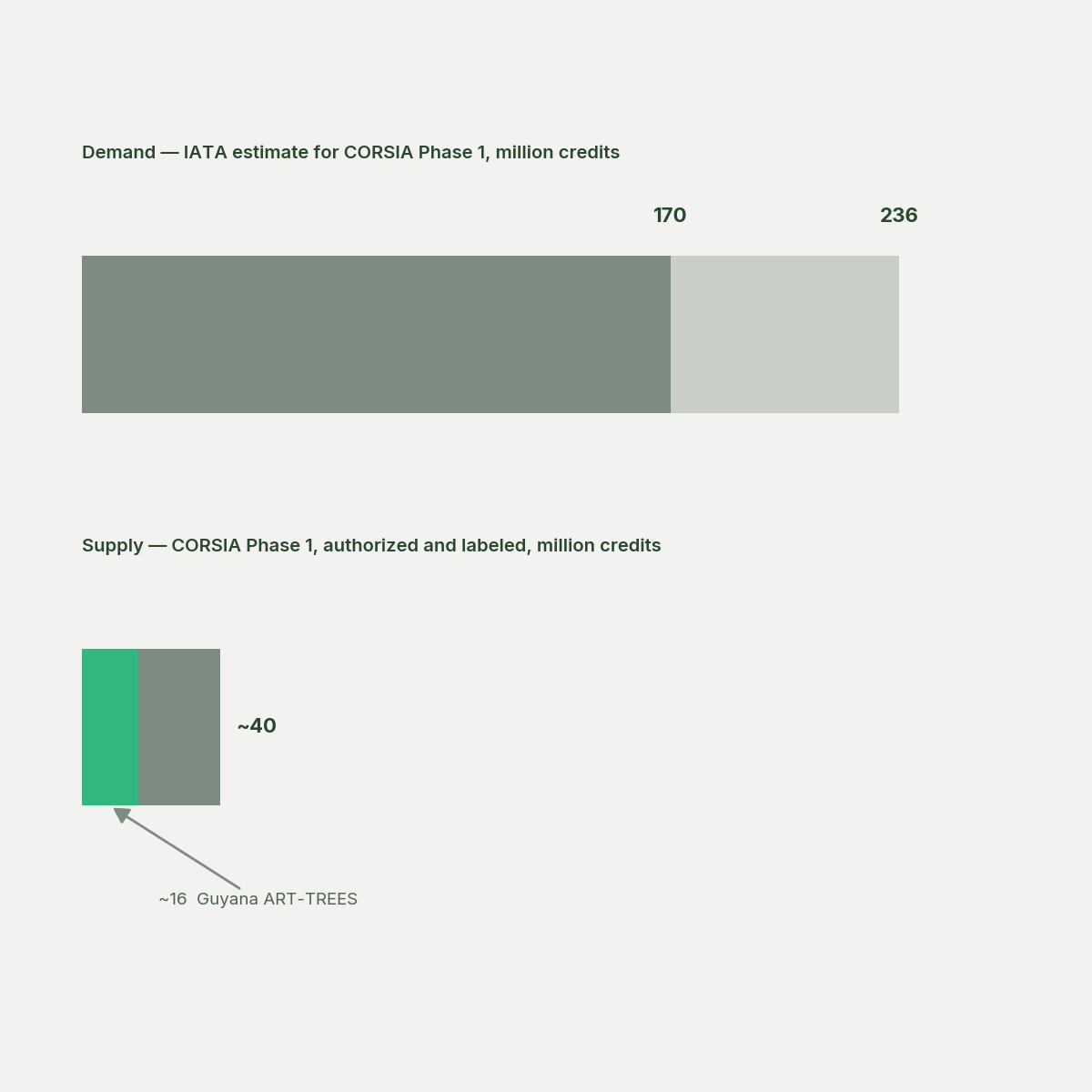
CORSIA requires international airlines to cover their emissions growth with carbon credits. IATA puts first-phase demand at 170–236 million. About 40 million are authorized and labeled today, roughly 16 million of which come from one forest program in Guyana.
A shortage that size should drive prices up. Instead, IATA's airline sales cleared at $22–23 in 2025, then prices fell below $10 in July 2026.
The physical decarbonization route is far more expensive. IATA expects sustainable aviation fuel at $2,872 a tonne in 2026 against jet fuel near $1,200. Credits are the cheap way to comply, and they still are not clearing.
The reason is enforcement. ICAO sets the rule, but each country writes its own penalties into national law. Most have not. Airlines have until January 2028 to cancel credits against 2024–26 emissions, and most currently face no consequence for missing it. What is missing is the obligation, not the supply.
The constraint on eligible forest carbon is not planting or verifying. It is host-country authorization, a signature rather than a project. I develop these projects, so weigh that accordingly.
Every one of these credits was issued in the voluntary market. A government signature made it compliance supply. Only government enforcement makes it demand.
When I started analyzing carbon prices in 2019, some thought the voluntary market might one day merge into compliance. Seven years on, it is marching toward compliance demand as its endgame.
Method
Approximate, and the two bars are not the same kind of number. Demand is IATA's Phase 1 estimate, published as a range, and it is charted as a range — the solid portion to 170 million, the lighter portion out to 236 — because drawing a range as one flat bar asserts a precision IATA does not claim.
Authorized and labeled supply is a tally of public trade reporting at end-June 2026. Guyana is its stated authorized Phase 1 volume rather than everything it has issued: Berkeley VROD v2026-06 shows roughly 25 million issued for 2021–23 vintages, not all of it authorized for airlines, and some already sold to non-airline buyers. The 2025 credit price is IATA's reported Q1 and Q3 airline sales, not an annual average.
The fuel comparison is dollars per tonne of fuel; a credit is dollars per tonne of CO2. They are not the same unit and nothing here claims they are. The point is narrower: the physical route costs an airline real money per tonne uplifted, the paper route costs under $10, and it is the paper route that is not clearing. Converting SAF into a cost per tonne abated would need a lifecycle-reduction assumption, and choosing one is the kind of move this publication exists to complain about.
What the shortage number cannot see is enforcement. ICAO is a UN body: it sets the scheme and does not police it. A penalty has to exist in each state's own law, and the coverage is patchy — the UK has written one at £100 per tonne, most states have not written one at all. An obligation with no penalty behind it is a forecast, not a liability, and the market is pricing it as one.
Sources
Every figure here is from a free, public, licence-clean source. No licensed price assessments are cited or charted.
IATA Phase 1 demand estimate, June 2026 — the 170–236 million range.
IATA press release, January 2025, and IATA-reported 2025 Q1 and Q3 airline sales — $21.70, $22.25 and $22.55 a credit.
IATA fuel fact sheet, updated June 2026 — SAF forecast at $2,872 a tonne for 2026, conventional jet fuel at $152 a barrel. https://www.iata.org/en/iata-repository/pressroom/fact-sheets/fact-sheet-fuel/
Government of Guyana / ART-TREES — 15.84 million authorized Phase 1 volume.
Berkeley Voluntary Registry Offsets Database v2026-06 — issuance by vintage. https://gspp.berkeley.edu/berkeley-carbon-trading-project/offsets-database
ICAO Assembly Resolution A41-22 — the January 2028 cancellation deadline for 2024–26 emissions.
EASA CORSIA implementation pages — enforcement sits with member states.
PRICED IN is published weekly by Real Heritage Group. What goes into a price — and what comes out of it.